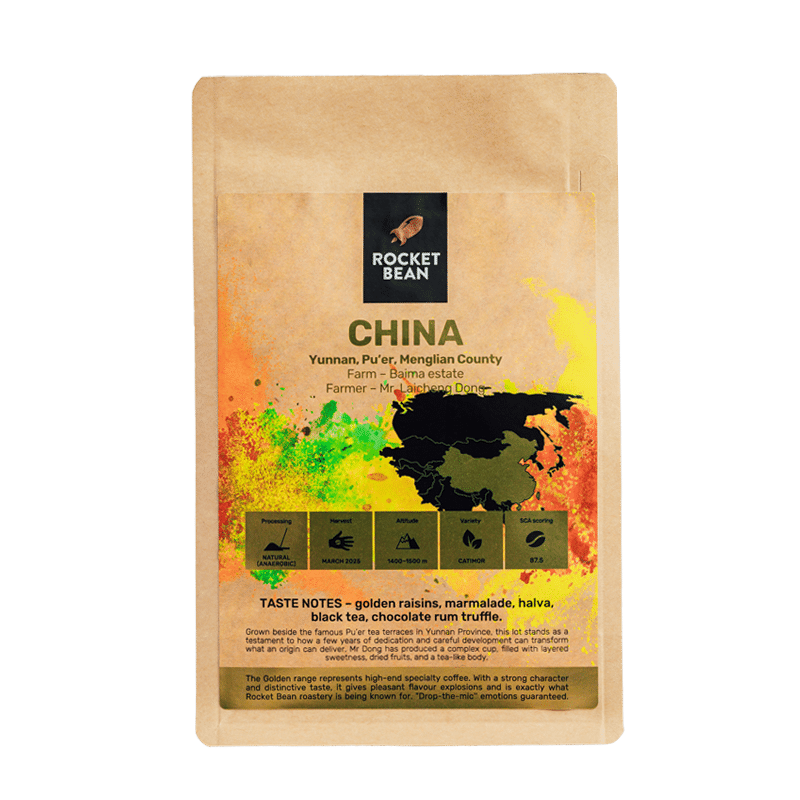

China | Yunnan, Baima estate, Anaerobic Natural
Filter
- Country: China
- Region: Yunnan, Pu’er, Menglian County
- Producers: Mr. Laicheng Dong
- Taste and Arome: Golden sultanas, marmalade, halva, black tea, chocolate rum truffle
20,50 €
Processing
Natural (Anaerobic)
Harvest
March 2025
Altitude
1400–1500 m
Variety
Catimor
Scoring
87,5
*We recommend resting this coffee for a minimum of one week after roasting to allow the flavors to fully develop before brewing.
Grown beside the famous Pu’er tea terraces in Yunnan Province, this lot stands as a testament to how a few years of dedication and careful development can transform what an origin can deliver. Mr Dong has produced a complex cup, filled with layered sweetness, dried fruits, and a tea-like body.
China
China (Chinese: 中国, pinyin: Zhōngguó) is located in East Asia. China is one of the world’s four earliest civilisations, with the Yellow River and Yangtze River as its cultural and agricultural cradles. Coffee was first cultivated in China in the late 1800s on a small scale, introduced by French missionaries in Yunnan. Large-scale production did not take off for nearly two centuries. It was only in 1988, as part of a government-led project assisted by the United Nations Development Programme and the World Bank, that coffee began to be commercially produced for export to other countries. Today, China produces approximately 1.8 million 60-kg bags of coffee (around 108,000 metric tonnes) annually, primarily in Yunnan Province. Production is expected to reach 1.9 million bags in the 2025 crop year. Despite this growth, China accounts for only about 0.06% of global coffee output, far behind leading producers such as Brazil and Vietnam.
Yunnan
Yunnan Province, located in south-west China, is the heart of Chinese coffee cultivation, responsible for over 98% of the country’s coffee production. The region’s mountainous terrain, fertile soil, and subtropical climate create ideal conditions for coffee growth. More than half of Yunnan’s production is concentrated around Pu’er, a region historically famous for tea. In 2024, Yunnan exported 32,500 tonnes of coffee, reflecting a 358% increase compared to previous years, signalling a shift from bulk commodity production towards high-quality speciality coffee.
The people of Yunnan are a highly diverse mix of cultures and languages, with most of China’s 56 officially recognised ethnic groups residing here. Typical farms grow the Catimor variety, often in full-sun plantations with 1,000–5,000 trees per hectare, depending on farming practices. Harvesting is mostly done by hand to select ripe cherries, and processing methods include washed, natural, and honey. Many farms, particularly those in Pu’er, are transitioning towards speciality-grade coffee and sustainable practices such as agroforestry, producing high-quality beans for both domestic consumption and export.
Diversity in this region extends beyond human populations to the region’s remarkable natural environment, which includes elephants, tigers, snow-capped mountains, deep valleys, subtropical jungles, beautiful lakes, and majestic rivers such as the Mekong.
Baima Estate & Mr Laicheng Dong
Baima Estate is managed by Mr Laicheng Dong. The farm is situated at an elevation of 1,400–1,500 metres above sea level, benefiting from the region’s fertile soil and subtropical climate. The name “Baima” translates to “White Horse,” inspired by the nearby Baima Mountain, known for its distinctive white flowers that grow across it.
Mr Dong’s journey into coffee cultivation began with a personal passion for the beverage—something relatively uncommon in a region traditionally dominated by tea culture. In the early years, he did not produce high-quality coffee, but over time, through innovative and sustainable farming practices, he achieved speciality-grade coffee lots that are well known across the globe. Due to water usage restrictions in the area, the farm mainly focuses on honey, natural, and fermented processing. The farm maintains a modest annual production of around 2 tonnes of Catimor, with the cupping score falling in the range from 84 to 88 points.
Processing
The coffee cherries are carefully hand-picked on the Baima Estate, ensuring that only ripe cherries are selected for the best cup quality. After harvest, each lot is meticulously sorted to remove unripe, overripe, or damaged cherries, as well as any foreign material. The selected cherries then undergo a controlled double fermentation inside Ecotact bags, which enhances flavour complexity and adds depth to the cup profile.
Once fermentation is complete, the cherries are partially dried using a mechanical dryer until they reach about 60% moisture. Mechanical drying is necessary due to the humid environment in the Yunnan region, which otherwise would increase the risk of mould development. After this initial drying, the coffee is rested and then moved to raised beds for final drying, following the classic natural processing method. This gradual, step-by-step drying process ensures even moisture distribution and optimal flavour development.
Finally, the beans are separated from the dried cherries and further dried to reach around 12% moisture. They are then rested and hulled before being packed into 60 kg bags, each marked with the “Made in China” seal, ready for safe transportation to the EU.


