Peru | La Coipa, Washed
filter
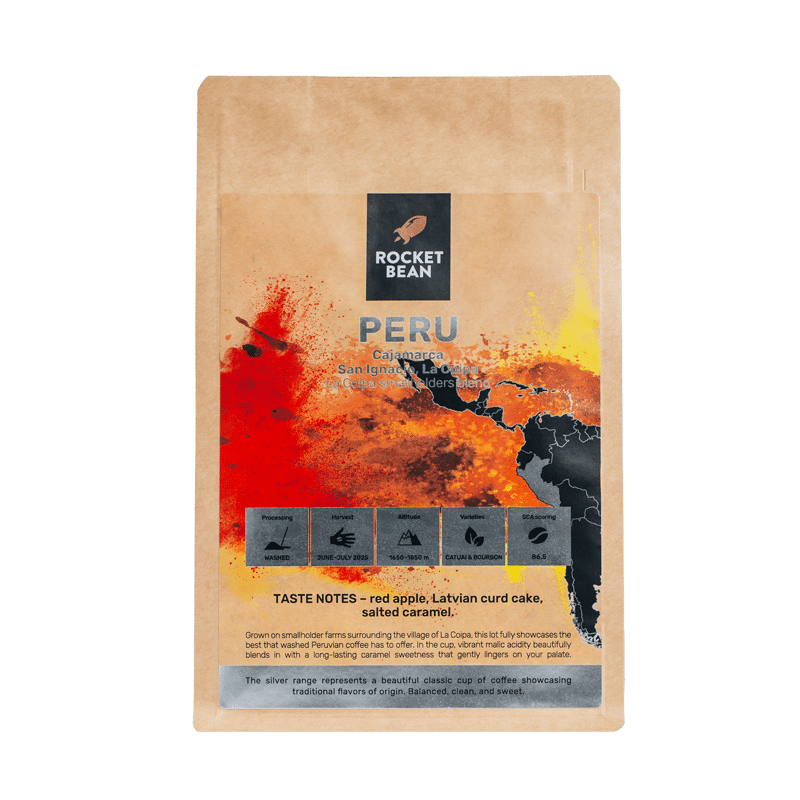
- Country: Peru
- Region: Cajamarca, San Ignacio, La Coipa
- Producers: La Coipa smallholders
- Taste and Arome: Red apples, Latvian curd cake, salted caramel
15,00 €
Processing
Washed
Harvest
Jun –Jul 2025
Altitude
1650–1850 m
Variety
Catuai & Bourbon
Scoring
86.5
Grown on smallholder farms surrounding the village of La Coipa, this lot fully showcases the best that washed Peruvian coffee has to offer. In the cup, vibrant malic acidity beautifully blends with a long-lasting caramel sweetness that gently lingers on your palate.
Peru & San Igancio
Peru is known for producing some of the finest coffee in the world, with a reputation built due to the unique geographic and climatic advantages of the origin. One of the key elements in this origin coffee’s outstanding cup profile is the Peruvian Andes Mountains. The high altitudes, ranging up to 2200 meters, slow the maturation of coffee cherries, which helps enrich coffee’s overall taste profile. Additionally, the volcanic soil in these regions enriches the coffee with distinctive tastes, while the cool temperatures and shade-grown methods help to minimise pests and bolster sustainable farming practices. These unique conditions create distinctive Peruvian coffee with intricate flavour profiles, bright acidity, and floral undertones. Coffee cultivation in Peru dates back to the mid-18th century when Spanish colonists first introduced coffee plants. Over time, coffee farming has become a cornerstone of the local economy, particularly in the high-altitude regions of this origin.
The San Ignacio region is located in northern Peru near the Ecuadorian border and is a part of a larger coffee-growing region called Cajamarca. It is one of the country’s most important coffee regions. It’s a green, mountainous area where many small family farms grow coffee at 1,200 to 1,900 meters. San Ignacio region produces around 12% of whole Peruvian coffee.
Coffee Varieties
Bourbon is one of the most culturally and genetically important C. Arabica varieties in the world, are known for excellent quality in the cup at the highest altitudes. It is also the most famous of the Bourbon-descended varieties and is a tall variety characterized by relatively low production, susceptibility to major diseases, and excellent cup quality.
French missionaries introduced Bourbon from Yemen to Bourbon Island (now La Réunion) – giving it the name it has today – in the early 1700s. Until the mid-19th century, Bourbon did not leave the island. But beginning in the mid-1800s, the variety spread to new parts of the world as the missionaries moved to establish footholds in Africa and the Americas.
The Bourbon variety was introduced to Brazil around 1860, and from there rapidly spread north into other parts of South and Central America, where it is still cultivated today.
Today in South and Central America, Bourbon has largely been replaced by varieties that descend from it (including Caturra, Catuai, and Mundo Novo), although Bourbon itself is still cultivated in El Salvador, Guatemala, Honduras, and Peru.
Catuai is a compact plant with a high yielding potential of standard quality in Central America. Very high susceptibility to coffee leaf rust.
It is a cross between highly productive Mundo Novo and compact Caturra, made by the Instituto Agronomico (IAC) of Sao Paulo State in Campinas, Brazil. The plant is highly productive compared to plants of Bourbon, in part because of its small size, which allows plants to be closely spaced; it can be planted at nearly double the density. The shape of the plant makes it relatively easy to apply pest and disease treatments. It is mainly characterized by great vigor and its low height; it is less compact than Caturra. The cultivar was created in 1949 from a crossing of yellow Caturra and Mundo Novo and was initially called H-2077.
Catuai, whose small stature allows it to be planted densely and harvested more efficiently, led in part to the intensification of full-sun coffee cultivation in South and Central America in the 1970s and 1980s.
Processing
This coffee lot is handpicked once the cherries have reached optimal sugar levels and ripeness by each farmer standing behind La Coipa coffee lot. After harvest, the cherries are rested for 24 hours and then mechanically pulped, separating the beans from the pulp. The beans are fermented in water tanks for 24-36 hours to remove any remaining fruit from the beans. They are then washed with clean water and dried on patios for 10 to 16 days before being prepared for storage. The parchment is then delivered to our partners, where the quality of each coffee lot is evaluated. Then all the lots that have passed the quality evaluation are blended to create a La Coipa blend. Finally, the coffee is shipped in 69 kg bags.


