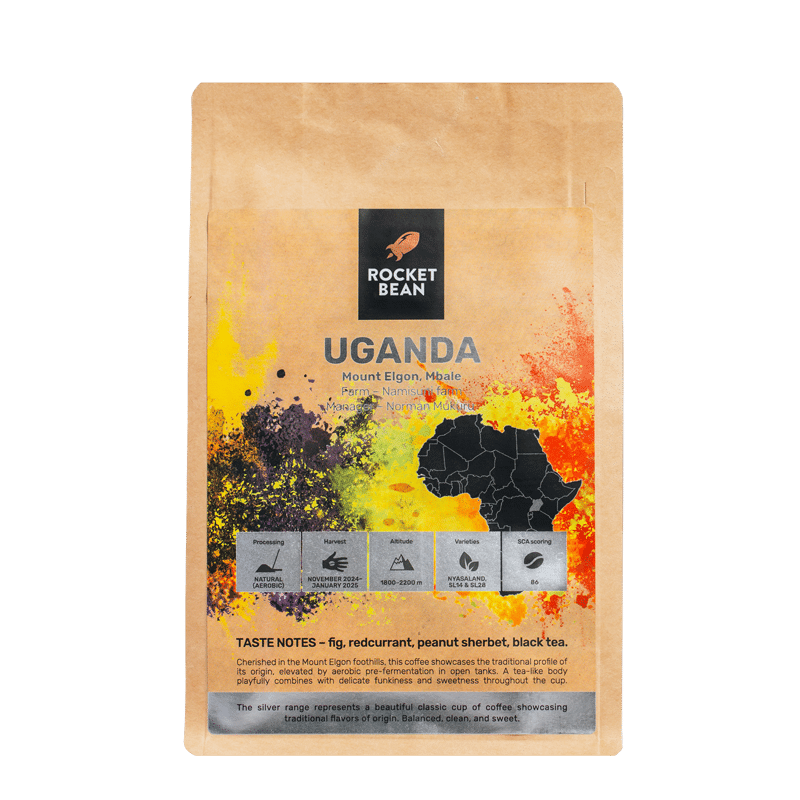
Uganda | Namisuni farm, Mount Elgon, Natural
filter
- Country: Uganda
- Region: Mount Elgon, Mbale
- Producers: Norman Mukuru
- Taste and Arome: figs, redcurrants, peanut sherbet, black tea
14,00 €
Processing
Natural (aerobic)
Harvest
Nov 2024 – Jan 2025
Altitude
1800–2200 m
Variety
Nyasaland, SL14 & SL28
Scoring
86
Nestled in the foothills of Mount Elgon, this coffee showcases the classic character of its origin, enhanced by aerobic pre-fermentation in open tanks. A tea-like body meets gentle funkiness and lingering sweetness.
Uganda
Uganda, often called the Pearl of Africa, earned this title from Winston Churchill, who visited in 1907 and was amazed by its beauty, saying it “shines like a jewel in Africa.” Uganda is also one of the few countries where coffee grows naturally as a forest tree. Wild Robusta coffee comes from its tropical rainforests, while Arabica was introduced during British colonial times in the early 1900s. Coffee has long been part of life for Uganda’s indigenous peoples, including the Baganda, Banyankole, and Bakiga, who have cultivated it for generations. The country’s coffee grows in different regions: most Robusta is grown in the central and western lowlands around Lake Victoria, while the largest volumes of Arabica come from the cooler, high-altitude areas of Mount Elgon and the Rwenzori Mountains. Uganda’s fertile volcanic soils, enriched by minerals from volcanic ash, along with abundant rainfall and two rainy seasons, provide ideal conditions for coffee cultivation. The Nile River, Lake Victoria, and numerous highland streams supply water that nourishes both the land and the coffee plants. Today, Uganda is Africa’s largest Robusta exporter and well known for its Arabica, that have high sweetness and complexity in cup profile.
Norman Mukuru
Norman Mukuru founded The Coffee Yard in the foothills of Mount Elgon, sourcing coffee from the districts of Sironko, Mbale, Bulambuli, and Kapchorwa—regions known for their fertile volcanic soils, high altitudes, and ideal rainfall. The Coffee Yard operates as a processing station where Norman develops his own coffee lots, sources and buys cherries from local farmers, and oversees their processing and quality improvement to deliver a spectacular cup profile. Having grown up in Uganda, Norman has a deep connection to the land and a lifelong passion for coffee. With nearly 20 years of experience in the industry, he has been producing natural coffees since 2018, constantly refining fermentation and drying methods to create the cup profiles that specialty buyers seek.
The Coffee Yard is not only a processing hub but also a center for farmer support, where Norman provides training and guidance to smallholder producers to improve quality and adopt sustainable practices. His hands-on approach, commitment to excellence, and focus on community development have made The Coffee Yard one of Uganda’s most respected specialty coffee operations—known for coffees that stand out both in flavor and in the positive impact they create locally.
Processing:
The coffee is first delivered to the Coffee Yard processing hub, where it is floated and hand-sorted to remove any underripe or damaged cherries. After sorting, the cherries are drip-dried on raised beds to remove excess surface moisture remaining from quality control. Once partially dried, the coffee undergoes a second separation, where cherries are sorted again by moisture level and colour to create uniform batches. Fermentation then takes place in either sealed barrels or open tanks, depending on the desired flavour profile. For more floral and delicate coffees, like this lot, fermentation is done in open tanks to preserve the profile without producing too many funky notes. After fermentation, the coffee is dried on raised beds for around 21 days, until the moisture content falls below 12%. The dried coffee is then rested and homogenised to even out moisture and flavour across the batch. Finally, the coffee is prepared for export, which includes sorting out defects, grading by screen size, and hulling, before its packed in 60kg bags and delivered to EU.
Similar products


