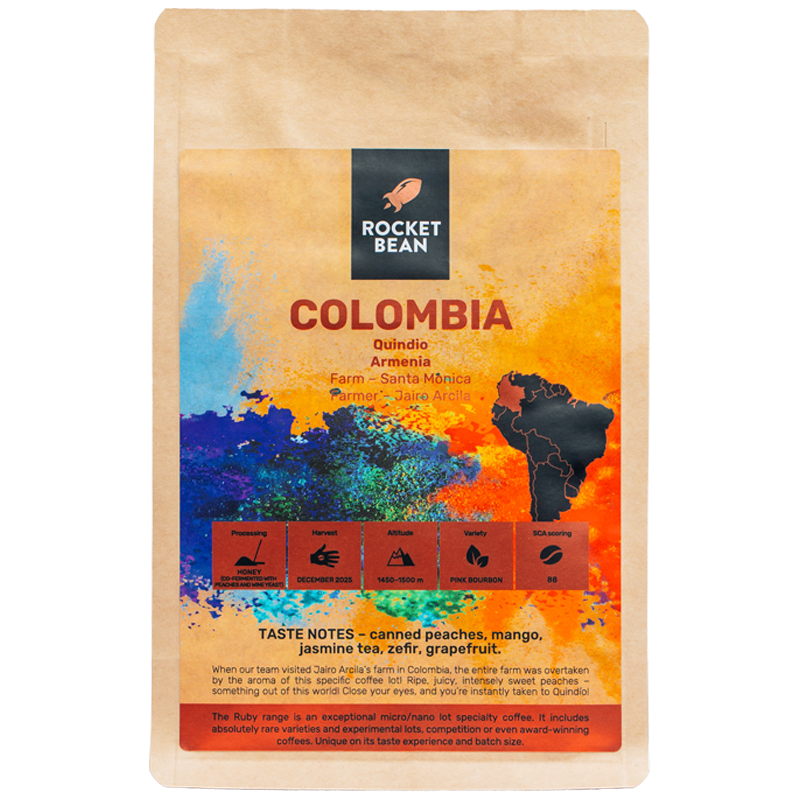
Colombia | Quindío, Armenia, Honey
Filter
- Country: Colombia
- Region: Quindío, Armenia
- Producers: Jairo Arcila
- Taste and Arome: Canned peaches, mango, jasmine tea, zefir, grapefruit
30,50 €
Processing
Honey (Co-fermented with peaches and wine yeas)
Harvest
December 2025
Altitude
1450–1500 m
Variety
Pink Bourbon
Scoring
88
When our team visited Jairo Arcila’s farm in Colombia, the entire farm was overtaken by the aroma of this specific coffee lot! Ripe, juicy, intensely sweet peaches – something out of this world! Close your eyes, and you’re instantly taken to Quindío!
Region
Quindío, located in the western central region of Colombia, is a UNESCO World Heritage site known for its lush green mountains, scenic landscapes, and thriving coffee industry. Quindío is part of the Coffee Axis, also known as the Coffee Triangle, which produces a significant portion of Colombian coffee yearly.
The climate in the region is ideal for coffee cultivation, with average temperatures ranging from 18°C to 24°C year-round and consistent rainfall. The Volcanic soil of Quindío provides excellent drainage and aeration, enhancing the flavour profile of the coffee. The altitude, ranging from 1400 to 1800 meters above sea level, also contributes to the unique characteristics of Quindío’s coffee, which is highly prized globally.
Historically known for commercial coffee, Quindío has relatively recently shifted towards specialty coffee. This change is driven by young farmers who see the potential for a sustainable livelihood in high-quality coffee production. In the past, low prices for commercial grades drove many young people away from coffee farming and to try opportunities in the bigger cities. However, today’s growing specialty coffee market offers better opportunities, encouraging the next generation to stay on the farms and improve coffee quality.
Most of the farms in this region are family-owned farms, typically 2 to 5 hectares in size, and produce traditional Colombian varieties and exotic ones like Gesha and Pink Bourbon. This focus on quality has led coffee from Quindío to regularly place at or near the top of Cup of Excellence competitions. Also, farmers often compete locally to see who has produced the best coffee lots. It helps to foster a vibrant local culture dedicated to quality and growth.
Farmer
Jairo Arcila is a third-generation coffee grower from Quindio, Colombia. His first job was with the second-largest exporter in Colombia, where he worked as their mill manager for over 40 years until his retirement in 2019. In 1987, Jairo bought his first coffee farm, Finca La Esmeralda, where Jairo planted his first Caturra lot. He was fortunate to earn money by producing coffee on his farm and working full-time. Using his savings, Jairo gradually purchased five additional farms: Villarazo, Mazatlan, Santa Monica, Maracay, and Buenos Aires. During the harvest period, within these six farms, Jairo can provide numerous jobs to locals, which has a significant economic impact on their community. As a farmer and producer, Jairo has learned from his experience and his two sons. With their help, Jairo has improved coffee picking, sorting, and processing at his farms.
His sons have also guided and encouraged him in the production of exotic varieties such as Pink Bourbon, Java, Papayo, and Gesha across all his farms. This synergy of generations has resulted in fantastic coffees with astonishing flavour profiles enjoyed around the globe.
Processing
This coffee is harvested following strict ripeness criteria, ensuring that only perfectly ripe cherries are selected. The cherries are then transported to a processing facility, where they undergo meticulous quality control procedures, including hand sorting and flotation, to remove any low density, underripe, or defective cherries. Next, the cherries undergo a 72 hour dry anaerobic fermentation. During this stage, peaches and wine yeast are added. In this stage, peaches impart their tropical fruit tone to the coffee, while the wine yeast efficiently converts sugars into alcohol and other compounds. This fermentation process helps to break down the mucilage more effectively, releasing organic acids and aromatic compounds that enhance the coffee’s complexity and flavor profile.
Following fermentation, the cherries are pulped to remove the outer skin while leaving the mucilage intact. This sticky, honey like layer is what gives the Honey process its name and contributes to the coffee’s sweetness and body. The pulped cherries are then transferred to a concrete patio or Elbas in Spanish, where they are spread evenly in thin layers. The cherries are carefully monitored and turned regularly to achieve uniform drying and to prevent over fermentation or mold. Drying continues until the cherries reach an ideal moisture content of 9.5%-11%, which is the perfect point for this coffee before it is rested and moved to hulling. At the end, coffee is packed in 24kg vacuum bags and transported to EU.
